58326291 odoslané zásielky
Vyberte client interface


Middle-mile delivery is the stage in which consolidated shipments move between warehouses, sorting hubs, fulfillment centers, and local courier networks. When it comes to cross-border eCommerce, it usually includes sorting parcels by destination, transporting them through an international line-haul network, and handing them over to a carrier responsible for the final delivery – or the so-called “last-mile” delivery.
The middle mile has a major influence on the whole transportation process. When it’s optimized correctly, it improves transit times, reduces costs, and directly supports end-customer satisfaction.
The main difference between first-, middle- and last-mile delivery is the role each stage plays in the shipment’s journey:
For example, an order shipped from a warehouse in Bulgaria to a customer in Romania may pass through all three stages: collection from the warehouse, consolidated transport between hubs, and delivery by a local Romanian courier.
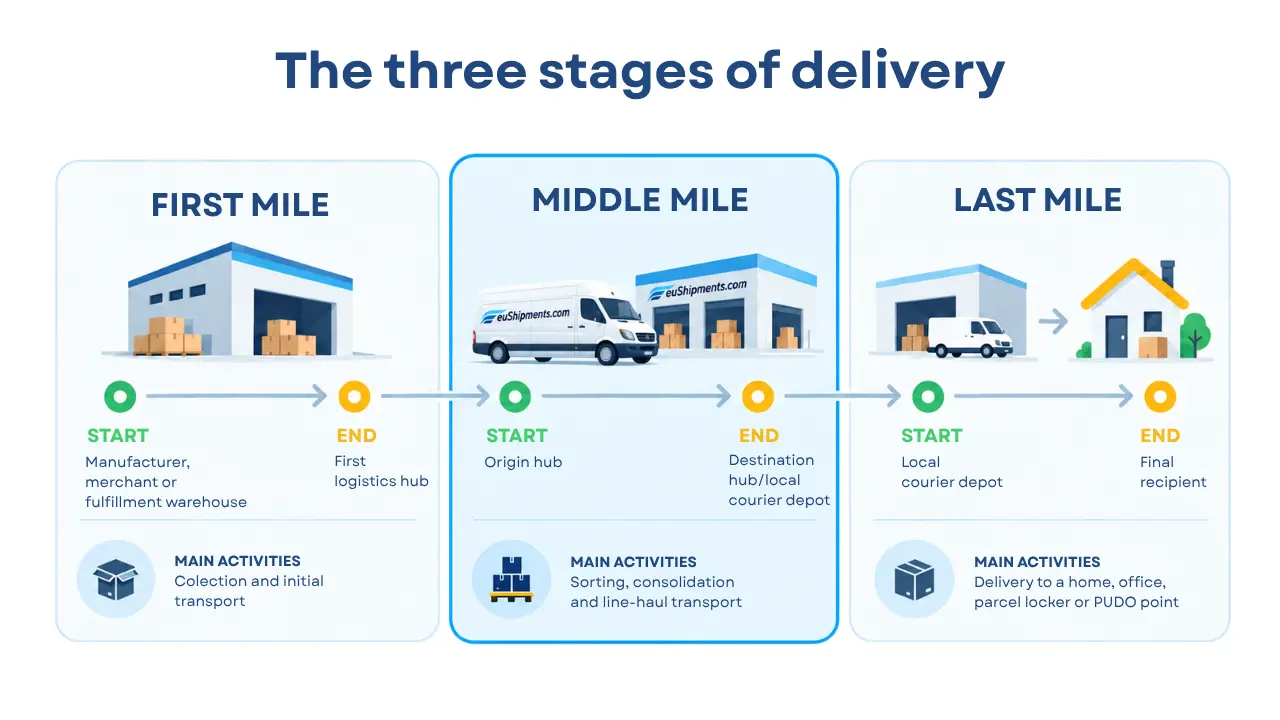
The exact boundaries between the three stages depend on the logistics setup. An online merchant may ask one logistics provider to manage the entire journey or arrange the first-mile collection themselves and inject the parcels into the network, where they are received and scanned at the agreed injection hub.
To learn how parcels enter the logistics network at the beginning of their journey, read our guide to first-mile delivery.
The middle-mile process at euShipments.com follows six key steps: receiving and sorting, consolidation, route assignment, transportation, unloading, and scanning. Here’s how each step works in practice.
*Line haul refers to the scheduled transport movement between logistics hubs.
**The loading manifest is a digital record of all consolidated shipment groups loaded onto a vehicle. It allows the operations team to verify the load, track its movement and confirm that every master barcode receives the expected scan after unloading.
A delay between hubs can affect the final delivery date. If parcels arrive after the local carrier’s processing cut-off, they may have to wait for the next delivery cycle. For the customer, the result is a later delivery, regardless of where the delay occurred.
In the majority of scenarios the middle mile is responsible for the largest part of the delivery distance, making cost and speed optimization at this stage particularly important. When done right – cross-border shipping becomes far more predictable, hassle-free and scalable.
Managing our own, independent line-haul network allows us to coordinate departures, adjust capacity and track shipments between hubs. For the online merchants, this means:
“An efficient middle mile is not simply about moving shipments between two hubs. It means consolidating and loading the right parcels, then handing them over to the right last-mile partner on time. When that synchronization breaks down, even a short delay can add a full day to the final delivery time. That’s why we continually review our network and operations, looking for ways to reduce waiting times and improve coordination between hubs and last-mile partners,” – Ashkhen Minasyan – Garabedova, COO & Board Member at euShipments.com.
A disruption in middle-mile transport can affect the delivery stages that follow. Parcels may miss their scheduled onward connection or arrive too late for the local carrier’s sorting cycle, pushing back the expected delivery date. For online merchants, this can mean more customer enquiries, additional work coordinating updates with their logistics partner, and even losing clients.
When an issue falls within our control, such as a missed departure, our operations team acts immediately. We arrange an alternative solution, even if this involves additional costs, to prevent the disruption from affecting the final transit time.
Some events remain outside our control. Road closures, severe weather, traffic accidents and customs inspections can disrupt even a carefully planned journey. In these cases, we proactively inform the affected online merchants, giving them time to update their customers and manage delivery expectations.

The top three key performance indicators we measure across our middle-mile operations are as follows:
These metrics help us identify recurring delays, discrepancies in unloading scans and routes with unused vehicle capacity. They also inform our ongoing review of routes and hub operations, helping us identify where adjustments are needed.
A practical question for middle-mile planning is whether parcels will reach the next hub in time for the onward connection. Routing and forecasting tools can support these decisions, but their usefulness depends on accurate shipment data and up-to-date information about capacity and processing times at each hub.
For online merchants, effective middle-mile planning supports more predictable shipping costs and delivery times. When choosing a logistics partner, it helps to understand how they handle disrupted routes, manage additional volume and communicate delays.
At euShipments.com, middle-mile delivery brings together parcel consolidation, scheduled transport and handover to local carriers. Managing our own, independent line-haul network helps us coordinate these steps and respond when plans change. Our aim is straightforward: getting our clients’ parcels to the last-mile partner in time for the next delivery stage.


